


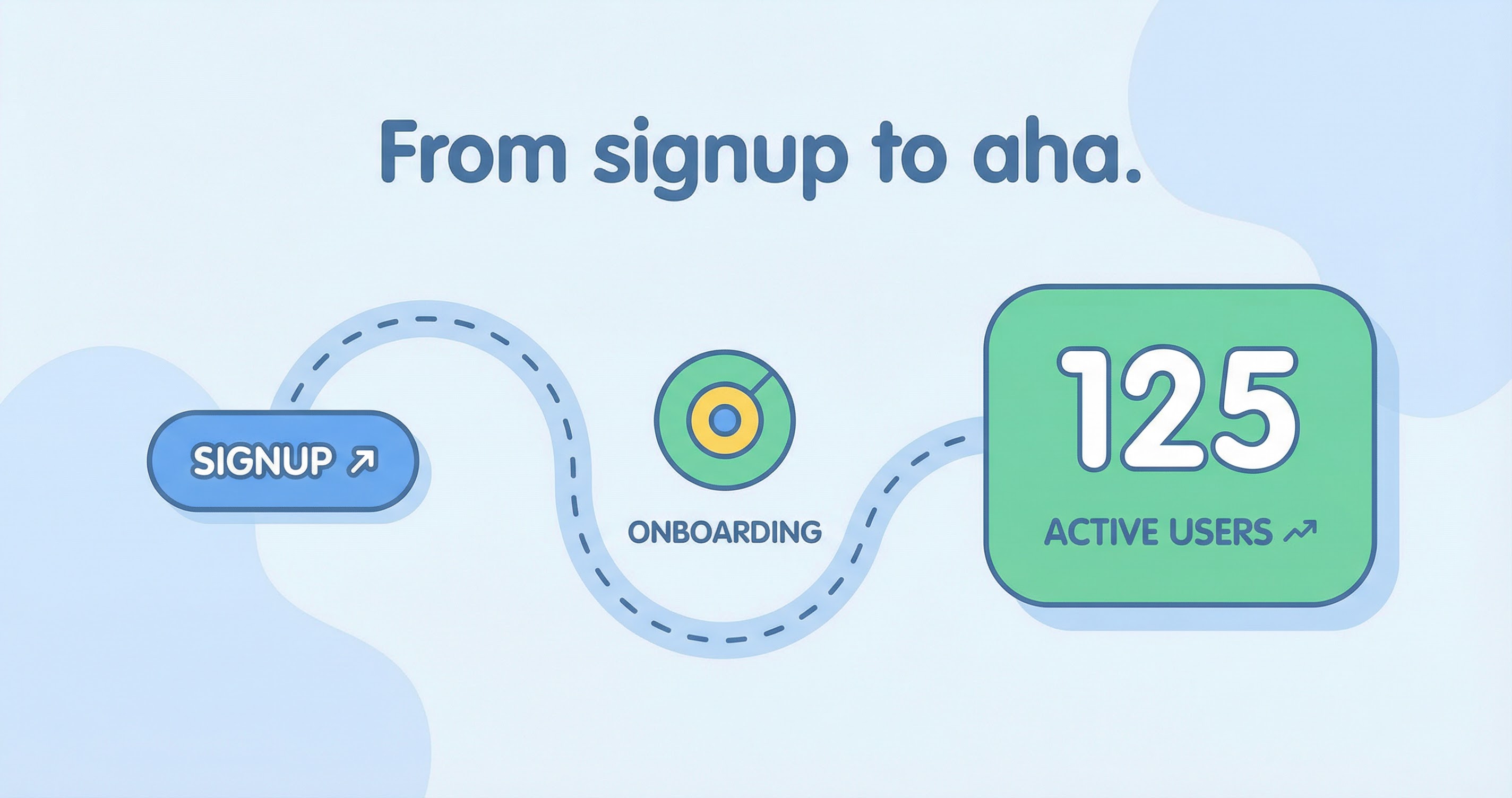
Why "first value" matters
Until a user gets a win, they're one step from churn. They signed up. They're in the product. But if they don't get to the moment where they say "okay, this is useful," they're gone. The faster they get there, the more likely they stay. That's why time to first value matters. It's the clock on the most fragile part of the journey.
Most products leak in that gap. Signup is easy to track. First value is harder to define. So teams track signups and hope. They don't know how long it takes to get to the aha moment. They don't know how many never get there. They don't know which onboarding change actually shortened the path. Without the metric, you're optimizing in the dark. With it, you have a target. Shorten the time. Get more people to the win. Watch retention follow.
Retention, expansion, and word of mouth all get easier when time to first value is short. Users who get value fast come back. They upgrade. They tell others. Users who drift for two weeks without a win churn. The metric is a leading indicator for everything that comes after.
Defining "first value" for your product
One clear action or outcome. First report generated. First match. First payment. First project created. Whatever "they got something out of it" means for you. Make it explicit. Then instrument it. If you can't measure it, you can't improve it.
The definition should be binary. They did the thing or they didn't. The metric is the time from signup to when they did it. Average time to first value. Or distribution: what percent hit it in a day, a week, a month? Both are useful. The key is that the event is unambiguous. No "engaged" or "active." A specific action that you can count.
Different products have different definitions. A project management tool might say "first project created." A dating app might say "first match." A SaaS tool might say "first report exported." The right definition is the one that correlates with retention. If users who hit "first value" in 24 hours retain at 60% and users who don't retain at 10%, you've found the right definition. Now shorten the path to it.
Measuring time to first value
Signup timestamp to first-value timestamp. Segment by source or cohort to see what onboarding or channel changes move the needle. Did the new onboarding flow shorten time to first value? Compare the cohort that saw it to the one that didn't. Did users from channel A get to first value faster than users from channel B? Segment and see. The metric is simple. The insights come from slicing it.
You'll want to track it over time. Is the average going down? Good. Is it going up? Something's wrong. Maybe the product got more complex. Maybe the onboarding got worse. The trend tells you. And when you ship a change, the product journal tells you what changed. So when the number moves, you know why. Cause and effect again. The loop that makes metrics useful.
Making it a team focus
Set "time to first value" as the active focus for a sprint or two. Watch the number. Ship to improve it. Use the product journal to tie cause and effect. When the number drops, you'll see the change in the journal. When it doesn't move, you'll know the change didn't work. Either way, you're learning.
Treat it like any other focus. One metric. One goal: shorten it. The team knows what to optimize for. Onboarding, email, in-app guidance, whatever gets users to the aha moment faster. When the sprint ends, you look at the number. Did it move? What did we ship? The journal has the answer. Then you decide: keep going or rotate to the next focus. Time to first value is one of the highest-leverage metrics most teams never watch. Once you start, it sticks.


