


The hidden cost of "powerful" tools
Custom dimensions multiply. Segments multiply. Dashboards multiply. Nobody owns them. The backlog of "someday we'll look at that" grows. Meanwhile the questions product needs answered stay unanswered. Did that change work? Where do people drop off? What's the one metric for our focus? Those questions don't need a data warehouse. They need a short path to an answer. The big platforms are built for the former. They can do the latter, but only if someone configures them, maintains them, and teaches everyone else how to use them. That someone is usually a data team. If you don't have one, the "power" of the platform becomes a tax. You're paying for flexibility you can't use and maintaining complexity you don't need.
The hidden cost is time. Time to set up. Time to maintain. Time to answer "can we see X?" with a new report or a new segment. When the product team has to wait on that, decisions stall. When the product team tries to do it themselves, they often get it wrong or they give up. The tool is built for experts. Most product teams are not experts. So the tool sits there, powerful and underused, while the team keeps asking questions that never get a good answer.
When the big platform makes sense
You have a data team or a dedicated analyst. Someone who lives in the data. Someone who can build the reports, maintain the segments, and answer the one-off questions. When that person exists, the big platform pays off. They can use the flexibility. They can build what the product team needs. The product team doesn't have to become analysts. They have analysts. In that world, Google Analytics or Amplitude or whatever makes sense. The investment is worth it.
You need cross-domain tracking, complex attribution, or heavy customization. Some questions really do require the full toolkit. Multi-touch attribution. Cross-device. Funnel analysis across a dozen steps. If that's your world, the big platform is the right choice. If your world is "did that feature work?" and "where do they drop off?" you probably don't need the full toolkit. You need a small set of product questions answered well. That's a different tool.
When to simplify
You're a small team or a PM without a data partner. You need a handful of product questions answered: did it work, where do they drop off, what's the one metric for our focus? You don't need the full toolkit. You need answers. You need them without learning SQL. You need them without filing a ticket. You need them in the same place you look every week. When that's the need, a simpler tool is the right call. Something built for product questions, not for analysts. Something that assumes the user is a PM, not a data scientist. Something that gives you one focus, a few metrics, a weekly summary, and a product journal. You don't need fifty dimensions. You need five questions answered well.
Simplifying doesn't mean you're dumb or your product is small. It means you're optimizing for the right thing. Speed to answer. Clarity. Habit. The big platform optimizes for flexibility. That's the right choice for some teams. For product teams without a data function, flexibility is often a trap. You need constraint. You need a tool that forces you to pick a focus and watch a few numbers. That's when simpler wins.
What "simpler" looks like
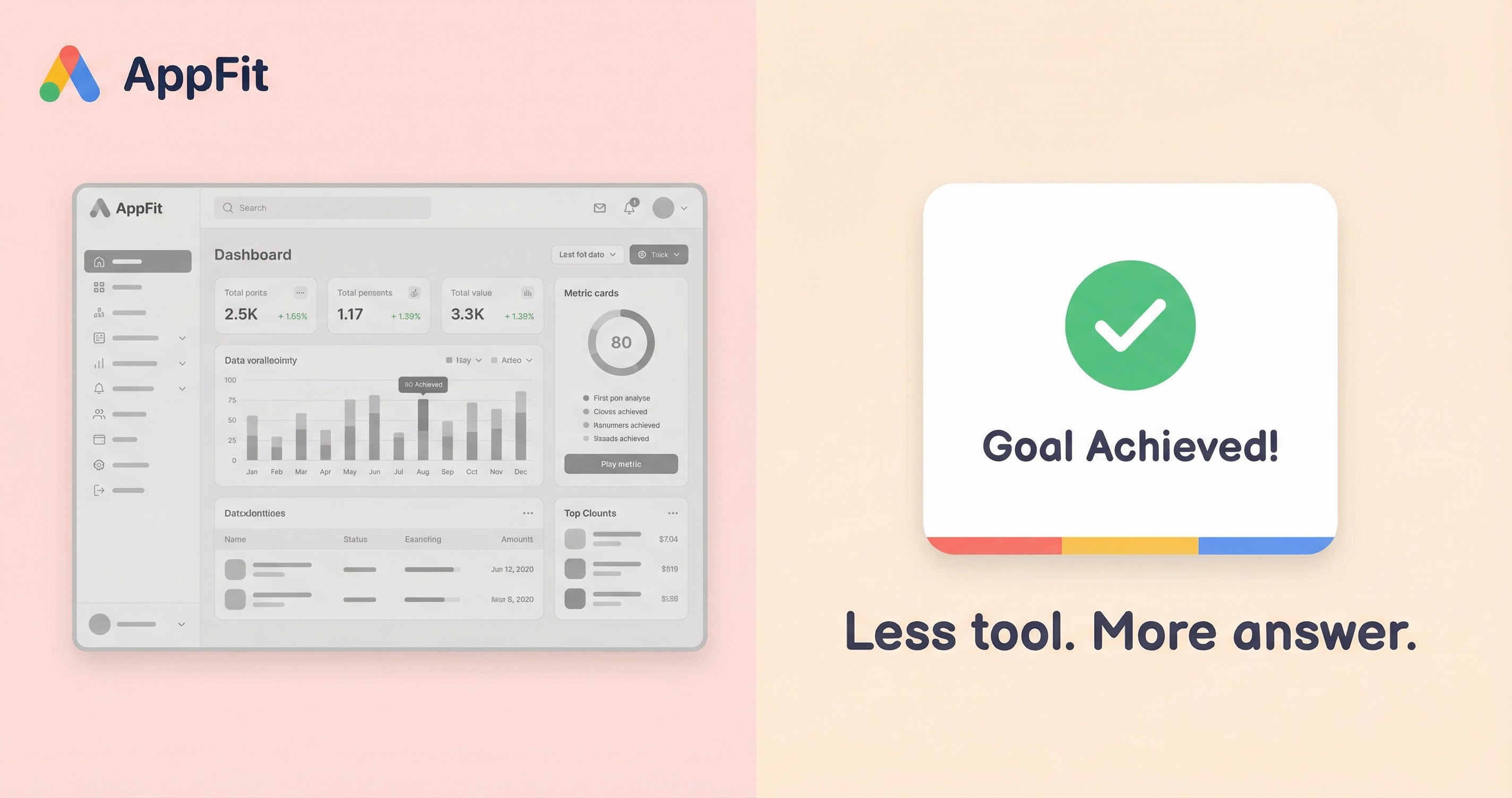
One focus. One cadence. One place to see what changed. Tooling built for product questions, not for analysts. That's what we're building with AppFit. You set a focus. You get the metrics that matter for it. You get a weekly summary so you don't have to remember to check. You get a product journal so when the number moves you see the cause. No custom dimensions to maintain. No dashboards to build. No ticket to file. Just the loop: focus, watch, ship, log, see what moved. The goal is to make the product question and the product answer live in the same place. So "did that work?" isn't a report request. It's a glance at the weekly summary and the journal. Simple. Fast. Built for the team that doesn't have a data person. That's when you skip the big platform and use something that fits.


